
Party Wall Agreements Explained: When You Need One and How It Works
By David Abbott, Director · · 7 min read
What people call a party wall agreement is really a notice process under the Party Wall etc. Act 1996. Here is which work it covers, the notice periods and what happens if a neighbour dissents.
A party wall agreement is the everyday name for the process set out in the Party Wall etc. Act 1996, which applies in England and Wales. You need to serve written notice on your neighbour if you plan to work on a wall you share, build a new wall on or at the boundary, or dig foundations within 3 or 6 metres of their building. If they consent in writing, you can go ahead once the notice period ends. If they dissent, or do not reply, surveyors draw up a party wall award that sets out how the work will be done.
The Act is separate from planning permission and building regulations. A project can need all three, and having one does not remove the need for the others. It does not give your neighbour a veto, but it does give them a say in how and when the work happens.
What counts as a party wall
The Act uses a few terms that are worth knowing:
- Party wall. A wall that stands astride the boundary between two properties, such as the wall between two semi-detached or terraced houses. It also covers a wall on one owner's land that separates both owners' buildings.
- Party fence wall. A garden wall that stands astride the boundary but is not part of a building. Timber fences do not count.
- Party structure. A wider term that includes floors and other structures separating buildings, such as the floor between two flats.
The three types of work the Act covers
Work to an existing party wall
Section 2 of the Act covers work to a party wall or party structure. Common examples on our jobs include:
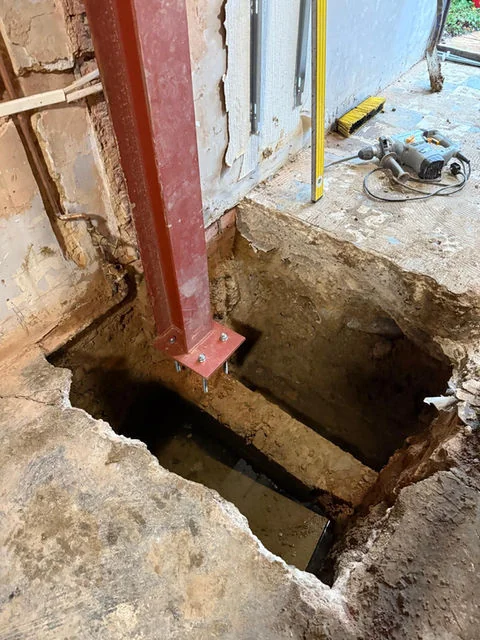
- Cutting into the wall to insert a steel beam, which is very common on loft conversions and rear extensions.
- Raising the height of the wall or building on top of it.
- Removing chimney breasts attached to the party wall.
- Underpinning, thickening or demolishing and rebuilding the wall.
- Inserting a damp proof course through the wall, or cutting in to fit flashings.
Minor jobs such as drilling for shelves, wall units or electrical sockets, or replastering, are not normally treated as notifiable. If you are unsure whether a wall is structural at all, our guide on how to tell if a wall is load bearing is a good starting point.
Building a new wall on the boundary
Section 1 covers building a new wall at or astride the line of junction, which is the boundary line between two properties. This often applies to extensions built right up to the boundary. If your neighbour does not agree to a wall astride the boundary, it must be built wholly on your land, although the Act lets you place projecting footings under their land in some cases.
Excavating near a neighbour's building
Section 6 covers digging foundations near a neighbouring building or structure:
- The 3 metre rule. Excavating within 3 metres of their building and deeper than the bottom of their foundations.
- The 6 metre rule. Excavating within 6 metres of their building where the excavation would cut a line drawn downwards at 45 degrees from the bottom of their foundations.
Many extension foundations go deeper than those of an older neighbouring house, so the 3 metre rule catches a lot of rear extensions, even where you are not touching the neighbour's wall at all.
Notice periods and how to serve notice
- Party structure notice (work to an existing party wall): at least 2 months before work starts.
- Line of junction notice (new wall on the boundary): at least 1 month.
- Notice of adjacent excavation: at least 1 month.
Notices must be in writing and should give your name and address, the address of the property, a clear description of the work, the proposed start date, and drawings where the work involves excavation. You must serve every adjoining owner, which can include a freeholder as well as the person living next door. You can serve notice yourself or ask a surveyor to do it. A party structure notice lapses if the work has not started within 12 months, so there is no point serving years ahead.
Notices can be shortened if your neighbour agrees in writing, which is one reason a friendly conversation before the paperwork arrives tends to help.
What your neighbour can do
Once they receive a notice, your neighbour has 14 days to respond. They can:
- Consent in writing. You can proceed once the notice period ends, without surveyors.
- Dissent. A dispute is treated as having arisen, and surveyors are appointed to resolve it.
- Not reply. After 14 days, silence is treated as dissent.
Dissent is not the same as refusal. It simply means the neighbour wants the work governed by an award, and in our experience it is a perfectly normal and sensible response, particularly where steel is going into a shared wall.
Agreed surveyor or two surveyors
If there is a dispute, there are two ways to appoint surveyors:
- An agreed surveyor acts for both owners. This is usually quicker and simpler.
- Two surveyors, one appointed by each owner. They then select a third surveyor, who is only called on if the two cannot agree.
Under the Act, surveyors must act impartially and resolve the dispute fairly, not argue for whoever appointed them. If your neighbour fails to appoint a surveyor within 10 days of being asked in writing, you can appoint one on their behalf. The owner carrying out the work normally pays the reasonable costs of the surveyors.
The party wall award and schedule of condition
The party wall award is the legal document that settles the dispute. It typically sets out:
- The work that can be done, with drawings attached.
- How and when it will be carried out, including working hours and access.
- Measures to protect the neighbour's property.
- A schedule of condition of the neighbour's property before work starts.
- Who pays the surveyors' costs.
Either owner can appeal an award to the county court within 14 days of receiving it, though this is unusual.
The schedule of condition is a written and photographic record of the neighbour's property, usually the rooms and walls nearest the work. If cracks appear later, it shows whether they were already there. We recommend a schedule even when a neighbour consents, because a dated set of photographs protects both of you. If the work does cause damage, the owner carrying it out must make it good or pay compensation.
What we see on Essex jobs
In Southend-on-Sea, and in neighbouring Leigh-on-Sea, much of the housing is Victorian and Edwardian terraces and semis, and almost any loft conversion in Southend-on-Sea involves steel bearing into the party wall, so a party structure notice is standard. Rear extensions there often bring in the excavation rules too.
In Grays there are a lot of semi-detached and terraced homes where a rear extension sits close to the neighbour's house, so the 3 metre excavation rule is the one we most often see. We cover the work we do in the town on our page about building work in Grays.
Colchester has a broad mix of older terraces and newer estates. On a detached house the Act may only come in through excavation, but on a terrace it is likely to involve the party wall itself. If you are planning house extensions in Colchester, build the notice period into your timeline, as we explain in our post on when to start planning an extension.
What happens if you skip the process
The Act does not make it a criminal offence to ignore it, but starting work without serving notice is still a bad idea. Your neighbour can apply to the court for an injunction to stop the work, and any damage claim becomes harder to defend without a schedule of condition. It can also cause problems when either of you comes to sell. Serving notice properly takes a little time up front and saves a great deal of trouble later.
To sum up: work out whether your project touches a party wall, the boundary or a neighbour's foundations, serve the right notice in good time, and treat dissent as a normal part of the process rather than a setback.
Frequently asked questions
On a semi-detached or terraced house it almost always does. Most loft conversions need steel beams bearing into the party wall, and many involve raising the wall or removing part of a chimney breast attached to it. All of these count as work to a party wall under the Act, so a party structure notice must be served at least 2 months before the work starts. On a detached house a loft conversion may not involve the Act at all, unless scaffolding or other work affects the boundary.
Not under the Party Wall etc. Act 1996. The Act gives you the right to carry out the work it covers, provided you follow the process. What your neighbour can do is dissent, which means surveyors decide how and when the work is done and record the condition of their property first. A neighbour can, however, object to a planning application, and planning refusal is a separate matter. Restrictive covenants and rights of light can also affect what you build.
Possibly. A detached house has no shared wall, but the excavation rules still apply. If your foundations will be within 3 metres of a neighbouring building and deeper than its foundations, or within 6 metres and cutting a 45 degree line down from them, you need to serve a notice of adjacent excavation. Building a new wall on the boundary line also needs notice. Many detached house extensions are far enough from the neighbour to avoid the Act completely.
Under the Act, the owner carrying out the work is responsible for making good any damage it causes to the neighbour's property, or for paying compensation instead if the neighbour asks. The schedule of condition taken before work started is what shows whether damage is new. Your builder should also carry insurance for damage caused by their work, which is worth checking before you sign a contract. Disputes about damage can be referred back to the surveyors under the award.
Thinking about a project like this?
Ask for a call back and Abbotts Build Hub will talk it through with you, or send us a message on WhatsApp with a few photos.