
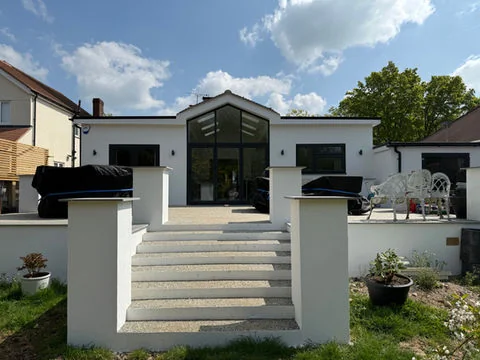
Extend or Move? An Honest Comparison for Essex Homeowners
By David Abbott, Director · · 7 min read
Extend or move? If the house is the problem, extending usually wins. If the plot, street or school catchment is the problem, moving is the honest answer. Here is how to tell.
If you like where you live and the problem is space inside the house, extending is usually the better answer. If the problem is the plot, the street, the school catchment or the commute, no amount of building work will fix it, and moving is the honest choice.
That is the short version. Below we set out how we talk it through with homeowners across Essex, from Brentwood and Billericay out to Epping: the costs of moving that people forget, the limits of what an extension can do, and the options that sit in between.
Start with what is actually wrong with the house
Most people who ask us whether to extend or move have a list of frustrations rather than one clear problem. Write that list down before you speak to an estate agent or a builder. Then sort each item into one of two columns: things that are about the building, and things that are about the location.
- Building problems: a kitchen too small to eat in, no downstairs toilet, a third bedroom that is really a box room, nowhere to work from home, a dark middle to the house.
- Location problems: a small or overlooked garden, no off-road parking, a busy road, the wrong school catchment, a long commute, neighbours you would rather not live next to.
Building problems can usually be solved with building work. Location problems almost never can. If most of your list sits in the second column, you probably already know the answer.
The real costs of moving
Moving costs are easy to underestimate because they are spread across several people and arrive at different times. None of that money goes into bricks and mortar. We are not going to put figures on them, because they depend on the price of the house and who you use, but get a quote or estimate for each one before you decide.
- Stamp Duty Land Tax on the house you buy, which rises with the purchase price.
- Estate agent fees on the house you sell.
- Legal and conveyancing fees on both the sale and the purchase, plus searches.
- Survey and mortgage fees, including any arrangement fee on the new mortgage or early repayment charge on the old one.
- Removals, storage and setting up the new house: carpets, curtains, appliances that do not fit, and the jobs you inevitably want done once you have moved in.
Put those categories next to an extension quote and the comparison often looks very different from the one you started with. Money spent on moving buys you a different house. Money spent on an extension stays in the one you already own.
Disruption: which kind can you live with?
Both options are disruptive, just in different ways. Moving means months of viewings, offers, chains that collapse and the stress of packing up a household. An extension means builders on site, noise, dust and a period when part of the house is out of action, usually the kitchen if the extension is at the back.
In our experience the disruption of an extension is more predictable. You know when we start, you know the order the work will follow, and with one in-house team covering building, plumbing, electrics and finishing there are fewer handovers between trades where things slip. Many families stay in the house throughout. A house move, by contrast, depends on other people's timescales that nobody in the chain fully controls.
Schools, commute and the street you live on
These are the things an extension cannot change, and they often decide the question. If your children are settled in a school you are happy with, or you are in the catchment for one you want, moving even a short distance can put that at risk. Check the admissions rules with the local authority rather than relying on what neighbours say.
The commute matters too. Plenty of the homeowners we work for in Brentwood and Billericay chose those towns for the rail links into London, and a bigger house further out can mean a longer journey every working day.
Then there is the ceiling value of your street. Every road has a price that houses rarely sell above, however much work has gone into them. If your house is already one of the most valuable on the road, a large extension may add more space than value. If it is one of the smaller houses on a street where most neighbours have extended, extending usually brings it in line. A local estate agent can tell you roughly where that ceiling sits, and it is worth asking before you pay for drawings.
What an extension can fix, and what it cannot
An extension is very good at adding usable floor area and changing how a house works. A rear or side extension can give you a kitchen big enough to cook, eat and sit in, a utility room, a downstairs shower room or a ground floor bedroom for an older relative. A two-storey extension can add bedrooms and a bathroom upstairs. Our house extensions service covers all of these, from the drawings stage to the decorating.
What it cannot do is make your plot bigger. Every square metre you build on the back of the house comes out of the garden. On a modest plot that trade can leave you with a lovely kitchen looking out on a patio and very little lawn. An extension also cannot create parking where there is none, and building over a driveway or garage can make parking worse.
There are limits on what you are allowed to build, too. Some single-storey rear extensions fall under permitted development, larger ones need planning permission, and the rules are tighter on some types of land. Our guide on whether you need planning permission for an extension explains the national rules, and your council's planning pages or pre-application advice will tell you how they apply to your house. Around Epping, where a lot of the surrounding land is Green Belt, it is worth finding out early what is likely to be acceptable.
The options in between: lofts and garages
Extend or move is not always a two-way choice. If the space you need is a bedroom, an office or a playroom, you may already have it under your roof or in your garage.
- Loft conversions add a bedroom, and often a shower room, without touching the garden. Many fall under permitted development, subject to conditions. You need enough head height in the roof space, so it is worth having it measured before you get attached to the idea. Our page on loft conversions in Billericay explains how we approach them.
- Garage conversions turn a space most people use for storage into a habitable room: an office, a playroom, a snug or an annexe. You can read more about our garage conversions.
Both are usually quicker and less disruptive than an extension, and either one can be enough to make a house work for another five or ten years.
A simple decision checklist
Work through these questions honestly. If you answer yes to most of the first group, extending is likely to make sense. If you answer yes to most of the second, moving probably will.
Points towards extending
- You like the area, the neighbours and the schools.
- Your commute works for you.
- The problems are about space and layout inside the house.
- You have enough garden to give some of it up.
- Your house is not already at the top of the street's price range.
- The extension you want falls under permitted development or has a reasonable chance of planning approval.
Points towards moving
- You need a bigger garden, more parking or a different plot.
- You want a different school catchment or a shorter commute.
- Your house is already one of the most valuable on the road.
- The only extension that would solve the problem is unlikely to get approval.
- You suspect you would still not like the house after extending it.
Getting the comparison right
The best decisions we see come from comparing like with like. Get a valuation and a list of moving costs from an estate agent, get an itemised quote for the extension from a builder, then put them side by side. We give free, no-obligation quotes for house extensions in Brentwood and across Essex, and we will tell you plainly if we think the work will not give you what you are after.
After more than 25 years of building and renovation, our view is simple: extend when the house is the problem, move when the location is. Most people know which one they are facing once they have written the list down.
Frequently asked questions
Not always, and not by the same amount everywhere. An extension tends to add the most value when it brings a smaller house up to the standard of others on the street, such as a bigger kitchen or an extra bedroom. It adds less when the house is already near the top price for the road. A local estate agent can give you a view on what an extended house might sell for, which you can then weigh against an itemised building quote.
Stamp Duty Land Tax is the one most people know about, but estate agent fees, conveyancing and searches on both sides, surveys, mortgage arrangement fees and any early repayment charge all add up. Then there are removals, possibly storage, and the cost of making the new house your own, from carpets and curtains to the first jobs you want done. None of that money adds anything to the house itself, which is why it is worth listing every category before you decide.
Often, yes. If what you need is an extra bedroom, a home office or a playroom, a loft or garage conversion can create it without using any garden. Both are usually quicker and less disruptive than an extension. A loft needs enough head height to work, and a garage conversion means losing that storage or parking space. We can look at the house and tell you honestly which option, if any, gives you the room you need.
Sometimes. A modest rear extension or a side extension can add useful space without taking much garden, and on some houses building up is a better answer than building out. Permitted development and planning policy both limit how much of a plot can be covered, so a very small garden may rule out a large extension. Think about how much outside space you actually use before deciding how much of it you are happy to give up.
Look at sold prices for your road and nearby streets on the property portals, paying attention to houses that have already been extended. Then ask one or two local estate agents for a free valuation of your house as it is and as it would be with the extension you have in mind. The gap between those figures, compared with your building quote, tells you whether the work is likely to pay its way if you sell later.
Thinking about a project like this?
Ask for a call back and Abbotts Build Hub will talk it through with you, or send us a message on WhatsApp with a few photos.