
Media Walls with an Electric Fire: Clearances, Ventilation and TV Size
By David Abbott, Director · · 7 min read
How to plan a media wall with an electric fire: clearances and ventilation, power, boards around the fire, the gap to the TV, viewing height and fixing a heavy screen safely.
Building an electric fire into a media wall is safe and straightforward, provided you follow the fire's installation manual to the letter. Inset electric fires produce real heat, so they need the clearances, ventilation and surrounding materials the manufacturer specifies, a properly installed power supply, and a TV positioned where the warm air will not reach it.
Every model is different, which is why we never work from a generic set of measurements. This guide explains the principles behind the numbers in your fire's manual, plus how to get the TV size, height and fixings right, so you know what to ask and what to check before the frame goes up.
Why an electric fire needs careful planning
An inset electric fire is a sealed box with a flame effect and, usually, a fan heater. The flame effect alone gives off little heat, but with the heater on the fire pushes warm air out through a grille, normally at the top or the front. That heat has to go somewhere. Boxed into a timber frame without the right space around it, a fire can overheat, cut out on its safety thermostat, discolour the paint or crack the plaster above the outlet.
None of that is a reason to avoid one. It simply means the fire is the first thing to choose, not the last. If you are still working out the overall look, our post on media wall ideas covers layouts, shelving and lighting; this post deals with the fire and the TV.
Clearances and ventilation: follow the manual
Every inset fire's installation manual sets out its own requirements, and they vary a lot between brands and models. Typically they cover:
- The opening size the fire box should sit in, with any tolerance around it
- Clearances to combustible materials above, beside and behind the fire
- Ventilation, usually an air inlet low down or below the fire and an outlet where the warm air leaves, so cool air can be drawn in and hot air pushed out
- Distance to shelves, mantels or projections above the heat outlet
- Whether the cavity behind needs to be open or closed, and what the frame can be made from
We read the manual for the exact model before we design the frame, and build the opening, vents and clearances around it. If you change your mind about the fire after framing, the opening often has to change too, so it pays to decide early. Treat any figure you see quoted online, including on social media, as being for that particular fire only.
Power: a dedicated supply
Electric fires draw a fair amount of current when the heater is running, so we give the fire its own dedicated fused spur rather than plugging it into an extension lead or sharing a socket with the TV and its boxes. The spur's switch sits somewhere you can reach easily, so the fire can be isolated without pulling it out of the wall.
Some fires arrive with a plug and others are designed to be hard-wired. Either way, the manual says how it should be connected and what the fuse rating should be. Our own electricians install and test the circuit and certify the work, which matters on something built permanently into a wall.
Boards and materials around the fire
A media wall is usually timber studs and plasterboard, both of which are fine for most electric fires provided the clearances are respected. Close to the fire, many manuals ask for something more: a non-combustible or heat-resistant board around the opening, a metal box or liner, or a specific gap to timber.
We use whatever the manual specifies, fix it properly and skim over it so the finish matches the rest of the wall. The area directly above the warm air outlet takes the most heat, so that is where we pay most attention to board choice, jointing and plaster, to avoid hairline cracks appearing after the first winter.
How far apart should the fire and TV be?
The fire and the TV compete for the same wall, and the TV is the more fragile of the two. Warm air rising from a fire below a TV can, over time, affect the screen, which is why many TV manuals warn against installing a set near or above a heat source.
The safe gap depends on where the heat leaves the fire. A fire that vents forward and down will need less space than one that blows straight up. Your fire's manual will often state a minimum distance to any object above the outlet, and your TV's manual may say something about heat too. We follow whichever is stricter and, where the room allows, add more. A projecting shelf or mantel between the two can help deflect warm air, if the fire's manual allows one there.
TV size, viewing distance and eye level
Choosing the TV is not just about the biggest screen the wall will take. Three things matter more:
- Viewing distance. The further you sit from the screen, the larger it can comfortably be. Measure from where your eyes will actually be on the sofa, not from the back wall. TV makers publish their own guidance on screen size against distance.
- Eye level. The most comfortable position is with the centre of the screen at, or a little above, your seated eye level. Putting a fire underneath pushes the TV up, so a slim linear fire helps keep the screen low.
- Angle. If the screen does end up higher than ideal, a tilting bracket angles it down towards the seating and cuts reflections from windows and lights.
Before framing, we often mark the TV and fire positions on the wall with tape so you can sit down and check the height for yourself. It takes ten minutes and saves a lot of regret.
Wall mounting: weight, noggins and brackets
Large TVs are heavy, and some brackets put a lot of leverage on the wall when the screen is pulled forward. Plasterboard fixings alone are not the answer. When we build the frame, we add solid timber noggins exactly where the bracket will be fixed, sized for the bracket and the TV's weight, and record where they are.
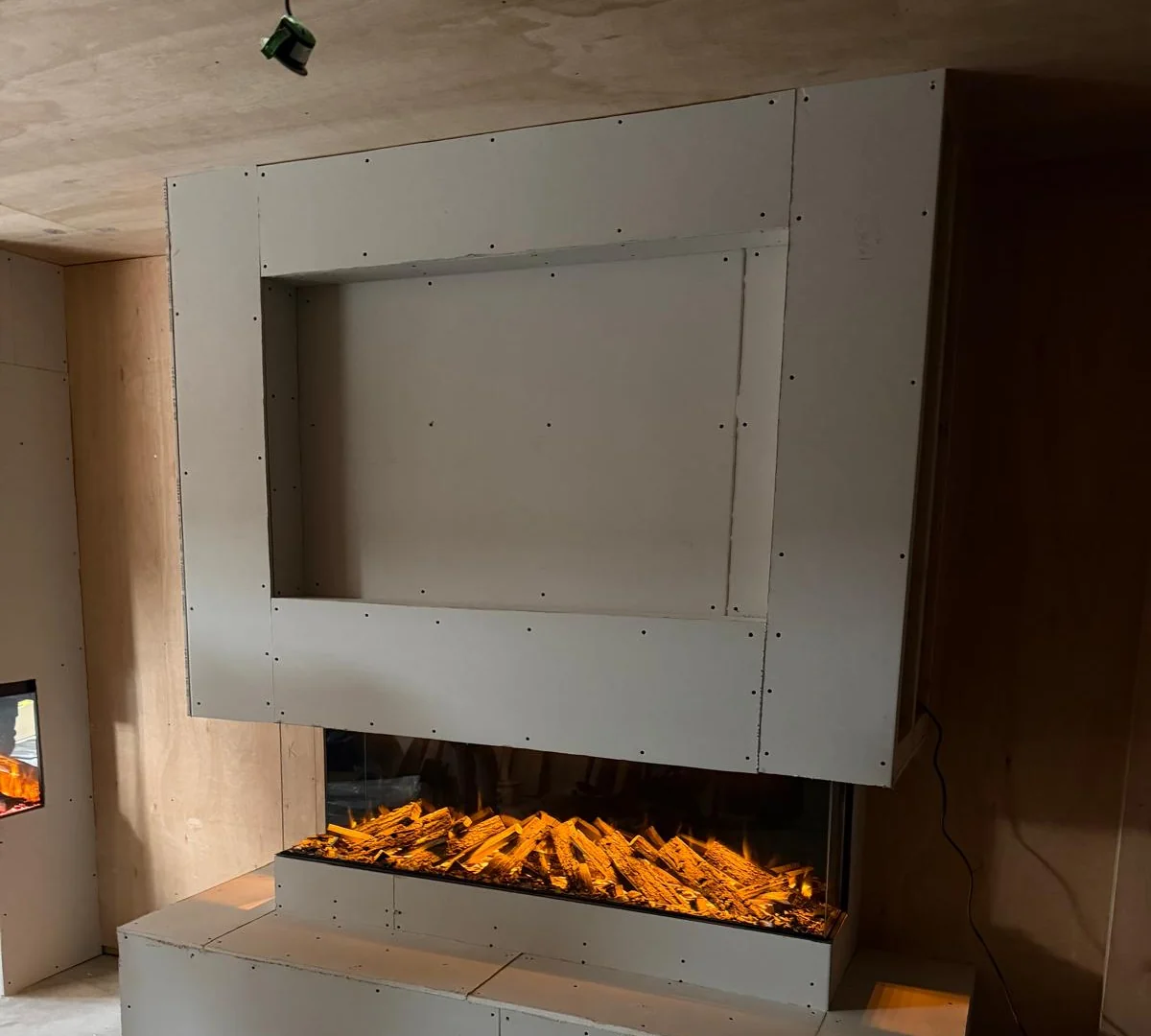
That means you need the TV and bracket chosen, or at least narrowed down, before the boards go on. You can see noggins being set into the frame around a recessed TV niche and a linear fire in our step-by-step media wall and fireplace build.
Choosing the fire: one-sided, three-sided and water vapour
Inset electric fires come in a few broad types, and each affects the build:
- One-sided (front-facing) fires show the flames through the front glass only. They are the simplest to frame and give the cleanest look on a flat wall.
- Three-sided fires have glass on the front and both ends, so the flames show from the side. They suit a fire set into a projecting box or a corner, but the side glass needs careful finishing at the corners and the clearances can differ from a one-sided model.
- Water vapour effect fires create a realistic flame and smoke effect from fine water mist lit from below. They need either a water supply or a tank you refill by hand, so the design must allow access for refilling and cleaning. Check the manual for what water the manufacturer recommends.
In Witham, Rayleigh and Benfleet we work in everything from 1960s and 1970s houses to post-war bungalows, and the right fire often comes down to the depth available and how the room is used.
Choose the fire and TV first, read both manuals, and build the frame, vents, power and fixings around them. Keep heat away from the screen, keep the TV close to eye level, and put solid timber behind the bracket. Do that and an electric fire in a media wall will look good and work safely for years. If you want the whole job done by one team, our media wall installation service handles the design, framing, electrics and finishing.
Frequently asked questions
Yes, almost all inset electric fires let you run the flame effect on its own with the heater switched off. That is how many people use them for most of the year, because it gives the look of a fire without warming the room. With the heater off, the fire produces very little heat, but you should still build in the ventilation and clearances the manual asks for, because the heater can be switched on at any time by anyone with the remote.
It can be, provided there is enough distance between the fire's heat outlet and the screen. Warm air rising from the fire is the concern, and the right gap depends on which way the fire vents and what both manufacturers say. Fires that vent forward or downward are kinder to a TV above. We check both manuals, use the stricter requirement, and may add a shelf or mantel to deflect warm air where the fire allows it.
Some inset fires come with a standard plug, while others are designed to be hard-wired into a fused spur. In a media wall we prefer a dedicated supply for the fire, because the heater draws a fair amount of current and you do not want it sharing a socket with the TV, soundbar and boxes. The fire's manual states how it should be connected and the fuse rating, and a qualified electrician should install and test it.
It depends on the model. Some water vapour fires are plumbed into a mains water supply, while others have a removable tank you fill from the tap and slide back in, usually from the front after lifting off a top panel or the glass. When we build one into a media wall, we make sure there is clear access for refilling and for the routine cleaning the manual describes, so you are not dismantling anything to top it up.
Cracking just above a fire usually comes from heat. Common causes are a clearance that is tighter than the manual specifies, the wrong board around the warm air outlet, or plasterboard joints sitting right where the heat rises. Fresh plaster that has not fully dried before the fire is used can also crack. It is worth checking the fire's manual against how it was built, and having the board and plaster around the outlet put right rather than simply filling the crack.
Thinking about a project like this?
Ask for a call back and Abbotts Build Hub will talk it through with you, or send us a message on WhatsApp with a few photos.