
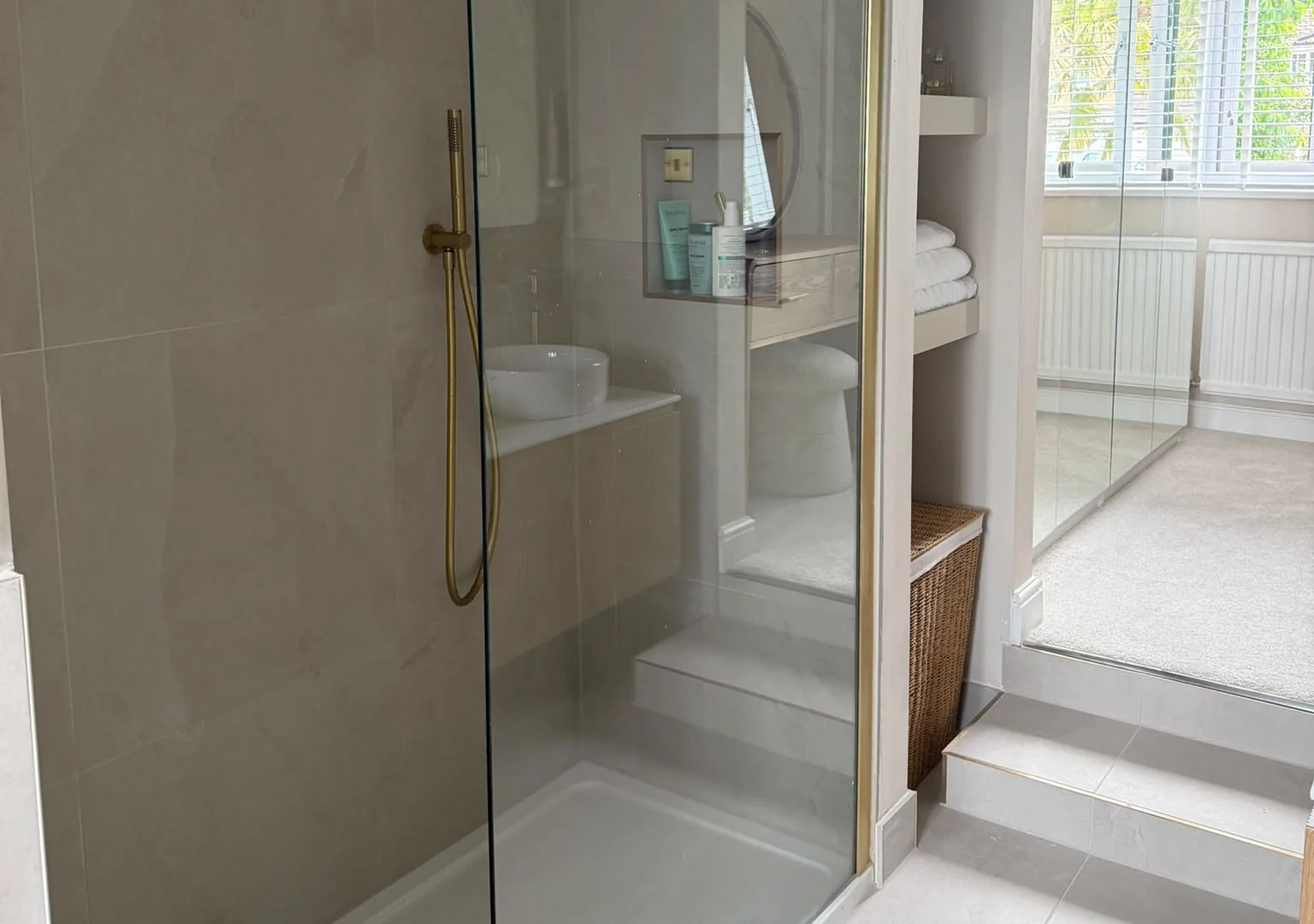
Bathroom Tiles: Choosing Sizes, Finishes and Layouts That Work
By David Abbott, Director · · 7 min read
Porcelain or stone, matt or gloss, metro or large format, herringbone or stack bond. How to choose bathroom tiles that look right, stay safe underfoot and last, plus why the prep matters most.
The best bathroom tile ideas start with the practical choices: porcelain for most floors and showers, a matt or textured finish with decent slip resistance underfoot, a tile size that suits the room, and a simple layout laid on a properly prepared surface. Get those right and almost any style you like will look good and last. Get them wrong and even expensive tiles will crack, stain or come loose.
We have been building and renovating bathrooms across Essex for more than 25 years, and when tiling fails it is almost always for the same reasons: the wrong tile on the floor, or a poor surface underneath. This guide covers what to choose, how to lay it out and why the preparation matters most.
Porcelain, ceramic or natural stone
Most bathroom tiles fall into three groups.
- Porcelain is made from finer, denser clay fired at a higher temperature, so it absorbs very little water and is hard wearing. It is our default for floors, showers and wet rooms. It is heavier and harder to cut, which matters for wall tiling and fitting time.
- Ceramic is lighter, softer and easier to cut, and there is a huge choice of colours and glazes. It is perfectly good on bathroom walls, but many ceramic tiles are not designed for floors or constantly wet areas.
- Natural stone such as marble, limestone, slate and travertine looks beautiful and every tile is different. It is porous, so it needs sealing and resealing over time, and some stones mark with acidic cleaners. It is also heavy, which affects what it can be fixed to.
Many porcelain tiles now do a convincing job of looking like marble, stone or concrete without the upkeep, which is why we fit far more of them than real stone.
Floor tiles and slip resistance
A bathroom floor gets wet, and wet tiles can be slippery. Before falling for a floor tile, check its slip rating. Tiles are commonly tested on a ramp and given an R rating, from R9 (least grip) up to R13 (most grip). As general guidance, we look for at least R10 on a bathroom floor and higher for a wet room or a level shower area, where the floor is regularly soaked. Some manufacturers also quote a pendulum test value, which is another way of measuring grip, so ask the supplier if you are unsure.
A few rules of thumb:
- Polished and high-gloss tiles are usually the most slippery when wet. Keep them for walls.
- Smaller tiles mean more grout lines, which add grip. That is one reason mosaics are popular on shower floors.
- Textured or anti-slip finishes give more grip but can be harder to clean, so there is a balance to strike.
If anyone in the house is older or less steady on their feet, slip resistance should come before looks.
Large format, metro or mosaic
Tile size changes how a room feels as much as colour does.
Large format
Big tiles mean fewer grout lines, a calmer look and less grout to clean. They suit most rooms, including small ones, as we touched on in our small bathroom ideas. The catch is that they need a very flat surface, because any dip or bump shows as lipping between tiles. They are also heavy, so the wall has to be up to the weight.
Metro
Metro or subway tiles are the small rectangular tiles, often with a bevelled edge. They are a classic choice and forgiving on walls that are not perfectly flat, which is useful in older houses. The trade-off is plenty of grout lines and slower fitting.
Mosaic
Mosaics come on mesh sheets and follow curves and the falls of a shower floor. They make a good accent in a niche or a feature strip, but a whole room of mosaic can look busy and takes a lot of grout to keep clean.
Matt or gloss
Gloss tiles reflect light, can brighten a dark bathroom and wipe clean easily. They show water marks and smears more, and on floors they are often too slippery. Matt tiles hide marks better, give more grip and feel more natural, especially stone-effect porcelain. A common approach is matt on the floor and in the shower, with a satin or gloss tile on the other walls to lift the light.
Layouts: stack bond, brick bond, herringbone and vertical
The same tile can look completely different depending on how it is laid.
- Stack bond lines tiles up in a straight grid. It looks clean and modern but shows any inaccuracy, so the walls need to be true.
- Brick bond offsets each row, usually by half a tile. It is traditional and forgiving. With long rectangular tiles we often offset by a third instead, because a half offset can exaggerate any slight bow in the tile.
- Herringbone sets rectangular tiles in a zigzag. It adds real character to a floor or a feature wall, but there is more cutting and more waste.
- Vertical laying, with rectangular tiles running upright, draws the eye up and makes a low ceiling feel taller.
Whatever the pattern, the tiles should be set out from the centre of the most visible wall or the line of the bath, so you do not end up with thin slivers of tile at a doorway or window reveal.
Grout, trims and feature walls
Grout colour has more effect than people expect. Matching grout to the tile gives a seamless look that suits large format. Contrasting grout, such as dark grout with white metro, makes the pattern the feature. Mid-grey is the most forgiving on floors because it hides everyday marks. Epoxy grout is slower to work with but resists staining, and it is worth considering in showers.
Edge trims finish the exposed edges of tiles at external corners, around boxing and where tiling stops partway up a wall. Metal trims in chrome, brushed steel, black or brass can match your taps and fittings, while a mitred edge gives a crisp finish on thicker porcelain.
A feature wall works best when it is limited to one area: the wall behind the vanity unit, or the back wall of the shower. A recessed niche lined in a contrasting tile or mosaic is a neat way to add detail without overloading the room. Our bathroom renovation projects show how some of these combinations come together.
Why the surface underneath matters most
Tiles are only as good as what they are stuck to. In our experience, cracked tiles, hollow-sounding tiles and loose grout nearly always trace back to the substrate rather than the tile itself.
- Walls. Old plaster and standard plasterboard are not suitable in wet areas. In showers we fit cement or waterproof backer boards, which are stable, strong and unaffected by moisture.
- Floors. Timber floorboards move. Before tiling we overboard with a suitable tile backer board, screwed down at close centres, so movement in the floor does not crack the tiles or the grout.
- Waterproofing. Shower areas and other wet zones need a waterproofing system behind the tiles. Tiles and grout on their own are not waterproof.
- Flatness. Large-format tiles need a flat surface, so we level floors and walls before setting out.
Tiling in Colchester, Southend-on-Sea and Grays
The age of the house shapes many of these choices. In the Victorian and Edwardian terraces common around Southend-on-Sea, walls are rarely straight and floors are usually timber, so forgiving tiles like metro on the walls and careful overboarding on the floor make sense. If you are planning one there, our page on bathrooms in Southend-on-Sea explains how we work.
Colchester has everything from period houses near the town centre to modern estates, and newer homes with flatter walls suit large-format porcelain in a stack bond. Our page on bathroom renovations in Colchester has more detail. We also tile bathrooms in Grays and across Thurrock, where the same rules apply: pick the tile for the room, then get the surface right.
Bringing it together
Choose the tile for where it is going first and the look second, keep the layout simple enough for the room, and make sure the surface underneath is right. We are always happy to look at samples with you and talk through what will work in your bathroom, and every quote we give is free and itemised.
Frequently asked questions
Sometimes, but we rarely recommend it. Tiling over tiles adds weight and thickness, which can leave sockets, trims, door frames and the edges of baths and trays looking wrong. It only works if every existing tile is firmly stuck and the surface is flat, and you cannot see what is underneath. If there is damp, a failed seal or loose plaster behind the old tiles, it stays hidden until the new tiles fail too. Stripping back lets us check the wall and fit proper backer boards.
They can be, as long as the floor is flat and stiff and the tile has a suitable slip rating. Big tiles mean fewer grout lines, which looks clean and is easier to keep tidy. On a timber floor we overboard first so the floor does not flex, and we may level it with a compound. In a shower area that falls to a drain, large tiles only work with a linear drain where the fall runs in one direction, otherwise smaller tiles or mosaics follow the shape better.
Yes. Marble, limestone, travertine and slate are porous, so they need sealing to stop water, soap and toiletries soaking in and staining. Stone is usually sealed before grouting, which stops grout staining the face, and again once the job is finished. The seal wears over time, especially in showers and on floors, so it needs reapplying periodically. Use cleaners recommended for stone, because acidic or harsh products can etch the surface. If that sounds like too much upkeep, stone-effect porcelain gives a similar look.
Mid-grey is the most forgiving for most bathrooms, especially on floors. White grout looks crisp when new but shows every mark and can discolour in showers, while very dark grout can show soap and limescale residue as pale streaks. Matching the grout closely to the tile colour also hides marks well. Whatever colour you choose, a good quality grout, sealed where the manufacturer recommends it, and a bathroom with decent ventilation will stay cleaner for longer. Epoxy grout is the most stain resistant option for showers.
Yes, we always suggest keeping a few spare tiles. Ranges are discontinued, and even the same tile from a later batch can vary slightly in shade. If a tile cracks after something is dropped, or a fitting needs replacing and leaves a gap, having the original tiles means a repair that matches. We plan for some waste when we order, for cuts and breakages, and any full tiles left at the end are handed back to you. Store them somewhere dry, labelled with the range name.
Thinking about a project like this?
Ask for a call back and Abbotts Build Hub will talk it through with you, or send us a message on WhatsApp with a few photos.